
Work was carried out between January and February 2026 to amend the LCIA Method for EXIOBASE. It is recommended to use the new version and discard the old version.
New mapping of elementary flows
A new mapping was made to map the original source of the EF 3.1 LCIA Method[1] to the elementary flow system of EXIOBASE v3.9.4.
The following impact categories were excluded from the method since they were not characterized by any elementary flow from EXIOBASE:
- Climate change-Land use and land use change
- Ionising radiation, human health
- Ozone depletion
Average characterisation factors were calculated for those EXIOBASE elementary flows that were found to be aggregated (for a whole group of chemicals), to which only disaggregated alternatives (chemical-specific flows) existed in the EF 3.1 method. In the case of hydrofluorocarbons (HFCs) and perfluorinated carbons (PFCs), the IPCC report[2] was used to obtain the characterisation factors.
HFC and PFC factors were found to overestimate climate change impacts significantly. Therefore, they were excluded from the Climate change and Climate change-fossil. The impact of these substances on climate change was also not taken into account in the previous releases of the database. Still, the database also includes with impact categories where these flows are included, see Figure 1. Users can use these if prefered.
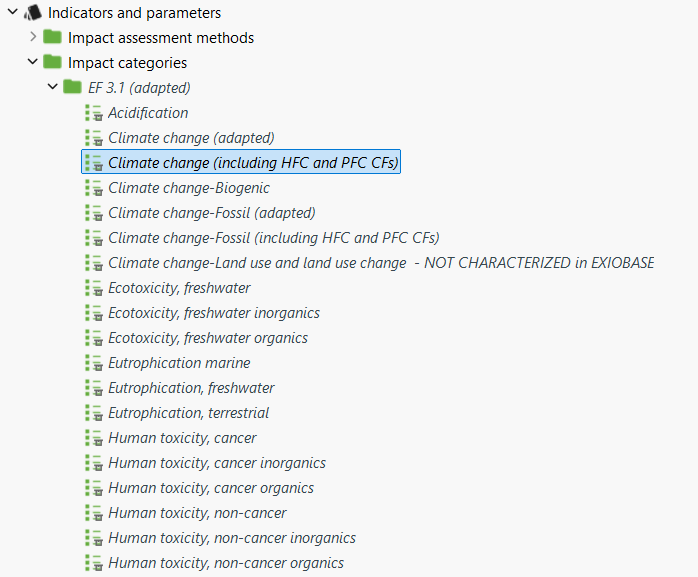
Figure 1. Impact categories of the adapted EF 3.1 LCIA Method
Changes with respect to the previous EXIOBASE 3.9.4 released for openLCA
The work on the update resulted in many new flows added to the characterisation factors tables, and some updates to already existing characterisation factors. The table below shows the differences.
Table 1. Changes from EXIOBASE v3.9.4 from the Nexus 24.07.2025 and the 13.02.2026 Nexus releases
|
Impact Category name |
Number of flows in 24.07.2025 |
Number of new flows added |
Number of flows with new characterisation factors |
|
Acidification |
0 |
53 |
0 |
|
Climate change (adapted) |
16 |
5 |
0 |
|
Climate change-Fossil (adapted) |
13 |
17 |
0 |
|
Ecotoxicity, freshwater |
3 |
23 |
10 |
|
Ecotoxicity, freshwater inorganics |
242 |
1 |
0 |
|
Ecotoxicity, freshwater organics |
197 |
18 |
0 |
|
Eutrophication marine |
87 |
33 |
0 |
|
Eutrophication, freshwater |
0 |
2 |
0 |
|
Eutrophication, terrestrial |
2 |
31 |
0 |
|
Human toxicity, cancer |
0 |
20 |
6 |
|
Human toxicity, cancer organics |
88 |
21 |
6 |
|
Human toxicity, non-cancer |
69 |
49 |
0 |
|
Human toxicity, non-cancer organics |
25 |
1 |
0 |
|
Human toxicity, non-cancer inorganics |
179 |
0 |
14 |
|
Particulate Matter |
147 |
148 |
0 |
|
Photochemical ozone formation |
80 |
127 |
0 |
|
Resource use, fossils |
31 |
2 |
5 |
|
Resource use, minerals and metals |
1 |
1 |
1 |
|
Land use |
0 |
0 |
31 |
Library format
The new update is available in the openLCA library format which allows for faster calculations and a faster workflow with the database. The user can still model as usual, and can copy and modify a process of the library. More on libraries in our manual.
New licence conditions
The EXIOBASE team have made a significant update in their licence conditions since v3.8.
Whilst academic licences are under CC-BY-SA-NC licence, any use by a commercial/for-profit entity requires an agreement with XIO Sustainability Analytics. You can email exiobase-support@googlegroups.com to arrange your licence. This has to then be registered in Nexus for its use in openLCA.
Contact EXIOBASE to obtain a commercial licence for EXIOBASE: exiobase-support@googlegroups.com
[1] https://eplca.jrc.ec.europa.eu/LCDN/developerEF.html
[2] https://www.ipcc.ch/site/assets/uploads/2018/03/sroc11-1.pdf